Saturday, July 23, 2011

Arizona Epic Part 1


Most people flee from Arizona in the summer, when temperatures commonly exceed 105 and even 110 degrees F. Not herpers. This week, hundreds of rattlesnake biologists flocked to Tucson, AZ for the Biology of the Rattlesnake II conference, which was cunningly planned by the organizers to occur smack at the beginning of the monsoon season. During monsoons, it might be hot but it’s also wet, bringing scaly critters (and their distant batrachian cousins) out in droves.

The first thing we did was ditch the opening night social to go herping. We met up with Karla M., a graduate student at Arizona State University studying Gila monsters. Although the rains have begun, Arizona has been hit hard by a drought over the past few years. But this didn’t deter us, because we were able to go to Stone Canyon, a gated upscale community and golf course that is heavily irrigated and therefore a heaven for herps. Karla is studying Gilas there, and a larger group of researchers mainly from the University of Arizona are conducting a long-term study of the snakes in the community.

Within 10 minutes of getting out of the car, we found two western diamond-backed rattlesnakes (Crotalus atrox) coiled up in the beautiful, lush Arizona Upland Sonoran Desert habitat. Here's a nice big male:


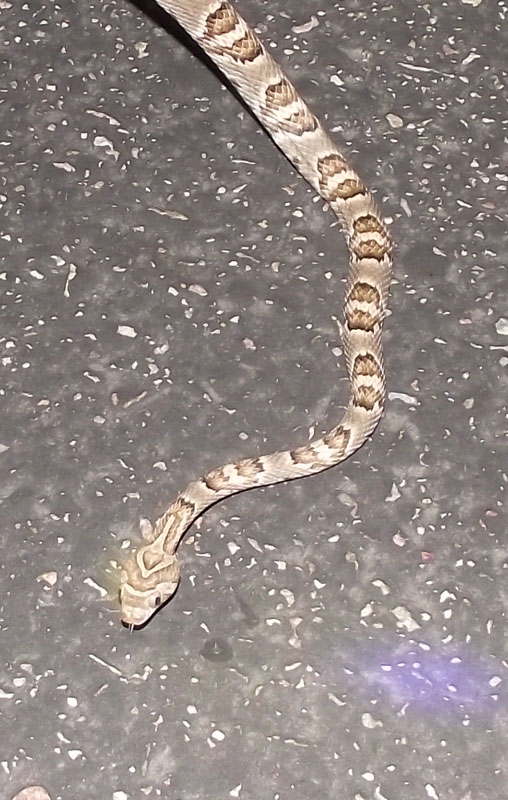
Next we began cruising around the road in Karla’s vehicle, looking for herps crossing the road. We immediately lucked out with this lyre snake (Trimorphodon biscutatus):


Lots of anurans were hopping around the roads, and several experienced the pleasure of meeting the grubby hands of my students. Here’s Scott admiring his first Sonoran Desert toad (Incilius [Bufo] alvarius), which he reluctantly refrained from licking:


Kory is holding a red-spotted toad (Anaxyrus [Bufo] punctatus):


Out wandering around the golf course, we found this big mellow blacktail rattlesnake (C. molossus), initially coiled under a plant right next to the green:


Back to the roads, we hoped to see one of the most common denizens of Stone Canyon, the tiger rattlesnake (C. tigris). This species is strongly associated with rocks, ranges widely in Mexico but has a relatively narrow distribution on the southwest US. We found this young of the year tiger on the road and he curled up nicely for a photo:


A few minutes later we found this adult out on the road:


Another photo of this guy:


We felt lucky to see some of the typical species, like C. atrox, C. molossus, and C. tigris, along with the amphibians, in this bad drought year. The lyre snake was a bonus. But we really lucked out when we learned that Karla needed to release a particularly prized and rarely seen snake that was caught earlier in the week. Check out this beautiful coral snake (Micruroides euryxanthus):


This guy got a lot of attention from the cameras:


To finish up the night, we jumped in Karla’s vehicle and drove out to her other field site, which incidentally was my field site during my graduate work, and is decidedly NOT benefiting from golf course irrigation. It was bone dry. Karla radiotracked four Gila monsters (Heloderma suspectum) she needed to check on, and along the way she showed us a contraption she built to monitor the temperatures within the nest of a Gila monster:


Despite the crummy, dry conditions, one of the Gila monsters was out walking around. This is a post-parturient female (check out the skinny tail):


Karla grabbed the Gila and took a blood sample because she is using doubly labeled water to examine water turnover and field metabolic rate in the animals:


Matt was very pleased to hold his first Gila monster:


The next night we went out for just a quick drive because we spent most of the evening snarfing fajitas and beer with the wonderful J-Ho and Keri. We went up the Catalina Highway and found two tiger rattlesnakes on the road. A young of the year:


And a good-looking subadult, 2 or 3 years old based on the rattle string:


Closer to Tucson there were a lot of anurans out and about, including spadefoot toads (Scaphiopus couchii):


By this time we had gotten about 8 hours of sleep total over the past three nights, and some of us couldn’t handle it:


Stay tuned for the next installment of AZ Herporama 2011!


Monday, July 11, 2011

Cal Poly Herpetology!

Well well well, I have been a delinquent herper-blogger. What happened to me? My job happened. I have just recently been able to uncoil myself from my massive load of book-writing, research, and teaching. BUT- this spring has been herp heaven and I have lots to show you all. Plus I am about to embark upon a summer like no other, so the blogs will be flowing freely... until school starts again!

I taught my fourth annual herpetology class this spring, and since it was the biggest and best ever (43 students!!!), I thought I'd start with that. Every year we add a new field trip, and the class is in glorious peril of becoming a field-only herpetology experience. Below you will see photos from the 2008-11 Cal Poly ZOO 341 Herpetology classes' field trips.

Most of the photos are not just the herps, but rather, of the REAL subject of my class: students holding herps!

The students first learn about the amphibians and reptiles in lab using preserved and (whenever possible) live specimens. Learning about desert tortoises as they wander around the table:

Then, it's off to the field, where we hunt critters and the students get schooled in the use of their field guides and how to write Grinnellian field notes.

San Luis Obispo Co is NOT a hotbed of amphibian diversity. But we nonetheless have a great time catching our local anurans and salamanders in wetlands near campus.

There is a series of old constructed trout ponds on a property near campus that the owner has converted into amphibian habitat. Each year our class goes to the property and seigns and dipnets for amphibians. Our job is to remove the invasive bullfrogs so that the healthy populationf of California red-legged frogs is protected. The students jump right in and pull a big net through the water, capturing all the critters:


We then go through the contents of the net:

Here is my TA Matt showing students a bullfrog larva:


And a student showing off an adult bullfrog he grabbed:


California newts are very common in these ponds:


Newt eggs:


Reptiles, in contrast to amphibians, are abundant and diverse in SLO Co.! We take students on trips all over the county. One popular trip is to Chimineas Ranch in the Carrizo Plain, where my lab does field work. There are some juicy junk piles there that are full of herps. Here is my TA Tony showing the students a northern Pacific rattlesnake found under some junk:


My grad student Nick with a striped racer:

A teeny pond turtle:


Admiring a small California kingsnake:

Western fence lizards are by the far the most common herp we see. This one is missing a leg and getting around just fine!

Thumbs up for coast horned lizards!

Alligator lizard earrings:

A good-looking Western yellow-bellied racer:

Northern Pacific rattlesnakes are thick as thieves at Chimineas. This year we found 16 rattlesnakes in a 3-hour hike! Photographing a snake from a respectful distance:

Courting rattlesnakes. That's the very attentive male on the right.


The Mojave Desert field trip is the capstone experience for the class. We stay at the Desert Studies Center in Zzyzx California in the Mojave Desert and spend two days hiking and night driving for herps. Best field trip ever!

The PERL crew preparing to drive the vans over to the East Mojave:


We spend some time every year herping at the Kelso Dunes, where you can find loads of lizards. It is important to protect oneself from the sun:

A western whiptail lizard:

A huge long-nosed leopard lizard:

And one of the most special lizards around, a Mojave fringe-toed lizard:
Mojave rattlesnakes, among the most "stimulating" of all rattlesnake species:

We do lots of night driving because this is the best way to find snakes. Students checking out a sidewinder on Kelbaker Rd.:

And a shovel-nosed snake:

Posing with a glossy snake:
Sometimes we see herps on the road during the day, too. In 2009 we found over 20 desert tortoises along Kelbaker Rd. in a single hour! That includes the big mama below. This was likely because the severe draught forced tortoises to the road edges where runoff increases vegetative growth.

Pisgah Lava Flow is a gorgeous place that I was introduced to in my Herpetology class at UC Berkeley:

Here's a collared lizard from Pisgah:

And its speckled rattlesnakes are incredible:


I am so lucky at Cal Poly to have great students, awesome colleagues, and an administration supportive of our herpetological endeavors. So supportive in fact, that Dean Phil Bailey of Cal Poly's College of Science and Math joined us on a field trip!