Sunday, September 5, 2010

Accidentally Acapulco

Every trip I take to Latin America is an adventure. I try to plan them that way, but they often end up being adventurous in ways I'd prefer to avoid. I've had my luggage stolen by banditos, I have made my way through Honduras during a military coup, and I've travelled around Guatemala on "goat and chicken" buses at a time when gringo buses were untravelable because they typically got hijacked. This past week Christy and I were supposed to be in Oaxaca volunteering at a sea turtle rescue, among other things, but the forces that love to tinker with my Latin American travel had other plans for us. Here's the tale of what transpired, along with the obligatory "photos of yummy food I ate on my trip" (and even a few herp photos at the end!).

A day before we left, Mexicana Airlines went bankrupt and cancelled all their flights. So our trip coordinator made us reservations on a bus (a nice one, no goats or chickens) that would take 13 hours overnight to get to Oaxaca from Mexico City. While we waited for the bus, we checked out a beautiful area of Mexico City called Coyoacan.


We ate duck taquitos and venison tostadas along with margaritas at an awesome little restaurant on the town square.


Then we were off to Oaxaca on the bus. Sometime in the middle of the night, the bus pulled over for a couple of hours to wait out a horrific deluge of rain. Apparently the road began falling apart in the rain because after that it was pothole city. At about 6am, over 10 hours into the bus ride, we discovered that the floods caused by the rain had knocked out a bridge on our route. Here's the spot where we hung around while the drivers figured out what to do.


And here's who we were sharing the wait with.


After a couple of hours, the drivers decided that the only choice was to turn around and go back to Mexico City. Why this took them so long to decide (as far as I know, even Mexican bridges don't regenerate themselves) is beyond me. You can imagine how we felt at the prospect of being in the bus for another 7+ hours. So I dashed into a tienda and got El Jimador and Squirt, and Christy made us gringo margaritas for the ride.


After a few hours it dawned on us that the bus was entering Acapulco. Having been on the bus for 18 hours, and unable to bear the idea of going back to Mexico City, Christy and I jumped ship at Acapulco and found ourselves a snooty hotel for a few days while we tried to figure out how else to get to Oaxaca. Meanwhile, everyone else in our group had gone earlier on a different route, so they were all smugly beginning the fun in Oaxaca.

Always adaptable and optimistic, we decided that Acapulco wasn't going to be so bad. We did a lot of this:


And quite a bit of this:


Check out this amazing prawn salad.


I must have eaten my weight in prawns the three days we were in Acapulco. I'm surprised I didn't turn into:


Molletes, one of the best breakfasts I've ever had:


Our lovely hotel even had Mexican versions of gringo condiments. In Mexico, soy sauce is called "jugo" (juice) and worchestershire sauce is called "salsa inglesa" (English salsa).


Meanwhile our trip coordinator was coming up with all sorts of plans to get us to Oaxaca. She could send a driver- no wait, the roads are out. We could go back to Mexico City and take a flight to Oaxaca. Why didn't we do that in the first place? Because Mexicana was bankrupt. Ah, there's another airline? Well, why didn't we do that in the first place? We got online to buy tickets, but this airline does not take American credit cards. Huh? Yeah, I know, makes no sense. We resolved to go to Mexico City in a few days and pay cash for the tickets at the airport.

In the meantime, we ventured into the city of Acapulco in search of El Mercado de Artesanias. Here's a panoramic view of the hotel zone (which was really quite icky and sewery; luckily we had chosen a hotel outside of the city, far to south).

At el mercado, we worked up quite an appetite haggling over ceramics, getting eaten by mosquitos, and goofing off.


We started looking around for food, and decided that chicken feet and unidentified meat laying around in the open was probably not for us, adventurous as we are.


We found a food stand and ate some yummy chiva tacos. Here's the vendor cutting into the goat's skull to make brain tacos. We didn't eat those.


In an effort to see something scaly, we went to a little botanical garden in the hills on the campus of Universidad Loyola. Here's a view of the outskirts of Acapulco from the garden:


Christy standing next to an incredibly giant green thing:


Beautiful very large ferns:


And even a few critters! Here are some Norops lizards in the garden.


A female Sceloporus:


Lots of Ameiva:


And even a forest frog! Pretty amazing, considering that the creek running through the garden was, in the same fashion as all creeks in Acapulco, a sewer.


It rained on and off while we were there, nothing major, but apparently inland and south there was A LOT of rain. Our final morning in Acapulco, I was getting some exercise at the hotel gym when the silent TV screen started showing images of severe flooding in Guerrero, Oaxaca, and elsewhere. The jist was something like this.

That was it. We had weathered the storms of cancelled flights, washed out bridges, and stone age airline websites, but we wouldn't weather this one. Back to the US we went. Yeah, not exactly the vacation we were hoping for. But it was still fun, and maybe I'll try the get to the turtles next year...

Thursday, August 26, 2010

Cookin' Babies

Viviparity is cool. It is characteristic of most mammals, no birds, and a relatively small proportion of invertebrate, fish, amphibian, and reptile species. In reptiles, it only happens in some lizards and snakes and their relatives. A few of our local herps like garter snakes, legless lizards, and rattlesnakes are viviparous. In fact, all rattlesnakes are viviparous, so don't be taken in by these gags:


Rattlesnake babies develop within little sacs in the mom's oviducts, seeing as how snakes do not have a uterus. Inside these sacs are the baby and a yolk sac, which are connected by an umbilical cord. A wee different from mammals, and perhaps even more cool.

Viviparity in reptiles is associated with interesting behaviors. Last week I was privileged to witness these behaviors in our local Northern Pacific rattlesnakes (Crotalus oreganus) at Montana de Oro State Park. A citizen herper called me up and invited me down to check out some snakes he has been watching all year. As we walked along a trail frequented by hikers, he pointed out a total of 12 rattlesnakes resting in loose coils on top of matted grasses. None of the passing hikers so much as noticed the serpents' presence. Probably a good thing, as noticed rattlesnakes often end up dead. Of the 12 snakes, two were males, one was a non-reproductive female, and nine were pregnant females. All photos are taken in situ, which is why the snakes are hard to see.

This guy is literally sitting right on the edge of the trail. We saw a bunch of people walk right past him.


And here are the prego girls. There are at least two reasons we saw so many pregnant snakes. First, we had lots of rain this spring, which intuitively means lots of primary production, which means lots of rodents, which means lots of snake food, which means lots of extra energy to make babies out of. Indeed, we witnessed tremendous mating activity this spring. Second, we likely saw more pregnant females out than non-reproductive snakes because the viviparous pregnant females need to sit on the surface to thermoregulate. I like to call this "cookin' babies."

Here's a female early in the morning on the way out of her rodent hole.


This female is stretched out in the grass, showing how hard the snakes can be to see at times.


Can you find the snake in this photo?


Here's a female sitting next to a shed skin that is clearly too large to be hers. There must be so many other snakes hiding nearby!


Typically after they emerge they will get settled into a tight or loose coil.


Here's a female doing a serious cookin' pose. Look at those swollen hindquarters.


Sometimes the pregnant females hang out in groups, in which case the location of the gathering is called a rookery. We found these two girls together, and my guide explained that there are often two others with them.


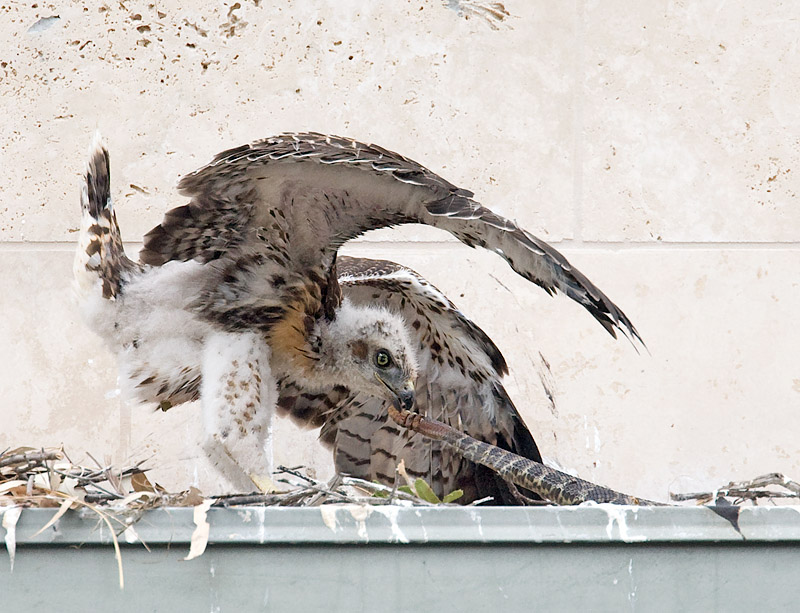
I am intrigued by this population of snakes, which lives in an environment so dramatically different from those we study inland. Here at the beach it is relatively cool year round, and importantly does not get very cold in winter. At our inland site, it gets incredibly hot in the summer and cold in the winter. There is a smorgasbord of small rodents here at the beach, and the snakes are somewhat small. Inland, the males are huge because they can grab ground squirrels and rabbits. Here at the beach (they are literally living just a few meters from the surf) the snakes probably experience an increased salt load relative to the inland population. How do their predators differ? Inland there seem to be more snake-munching badgers and birds of prey, like this redtail hawk parent feeding its baby:


(I got the amazing hawk photos here, and the photographer is not identified.)
Thank you to Dave for showing me these amazing beasties! I can't wait to see all the snake baby biomass that will result. Any day now!

Monday, August 23, 2010

Southeast Arizona Heaven

Ever had a therapist or hypnotist ask you to envision yourself in your happy place, maybe a white sand beach or a fern-covered forest hideaway? OK, me neither, but I've seen it on TV. Love those beaches and ferns, but my happy place isn't quite so commonplace. It is the Chiricahua Mounatins in southeastern Arizona. Last month I took Tony and Scott on a herping roadtrip to this magical place and a few others nearby. I am not a good photographer, and the monsoon rains prevented me from takng many bad photos. Here are the ones fit to spit on.

After a shotgun visit through Phoenix to see Saskia Brad and Kai, and Dale and Dianne, we got to the herping. We started out by meeting my friends Roger and Wendy at the Suizo Mountains, which are in the Sonoran Desert lowlands outside of Tucson. Roger radiotracked some tiger rattlesnakes (Crotalus tigris) and western diamond-backed rattlesnakes (C. atrox), like this girl here.


Here's another doing its "summertime open air market" bit:

Roger was releasing a Gila monster (Heloderma suspectum) that had just had its transmitter removed. Here's Scott wishing him good luck.


Scott found a beauty of a glossy snake (Arizona elegans):


And I found this nice black coachwhip (Masticophis flagellum) in the morning:


We spent the next evening radiotracking Gila monsters at the Owlhead Buttes, my old field site, with some of Dale DeNardo's graduate students. But after tracking just 4 animals we got completely rained out. No photos, but amazingly 3 of the 4 Gila monsters were the same ones that I and Dale had first captured and implanted with transmitters 10 years ago!

Heading ever southward, we met up with my friends Justin Keri and Corbin who live at the base of the Catalina Mountains, and then my friends Melissa, Jeff, and John met us up in said mountains. I never spent a lot of time here when I lived in AZ, but they are gorgeous.


We saw about 7 or 8 of these Sonoran whipsnakes (M. bilineatus):


And the creek was full of black-necked garter snakes (Thamnophis cyrtopsis):


No rattlesnakes out though; it was pretty overcast and cool. We spent the next night in the Pinalenos, but again not much of anything out. Time to head to the Chiricahuas.

Here they are from Onion Saddle:


The creek near our campsite, which I have now been going to for 11 years:


Melissa, Jeff, Tony, and Scott at our campsite:


Now, some critters. Melissa is holding a big male blacktail rattlesnake (C. molossus) captured near the Southwest Research station:


Here's a nice rock rattlesnake (C. lepidus) from Cave Creek area:


Two Sonoran Mountain kingsnakes (Lampropeltis pyromelana) were found, here's one:


Tony and Scott with shit-eating grins over their first pyro:


The typical lizard mafia was everywhere. Here is a striped plateau lizard (Sceloporus virgatus) on the left and a Yarrow's spiny lizard (S. jarrovi) on the right:


We went up to Barfoot Park, which is a famous spot for viewing twinspot rattlesnakes (C. pricei). They have been researched heavily here, likely because the beautiful talus slide is so gigantic that it houses a massive population of these guys:


I love this next photo. It looks like the sky behind the trees, but it's actually the giant hillside of talus!


Indeed, we immediately found a few pricei, including this guy:


We did a bunch of night driving, but unfortunately many of the critters were dead on the road. I've never seen traffic on Hwy 80 like this before! 3 of every 4 vehicles were Border Patrol, and we got "harassed" constantly. I say that in quotes because they were in fact quite friendly, and of course I am happy that they are there doing their important jobs. But it's hard to stop for a snake when you are being high-beamed and tail-gated by a patroller.

Here's a nice longnose snake (Rhinocheilus lecontei) we found on Hwy 80:


We visited our friends at the beautiful new Chiricahua Desert Museum, and were overwhelmed by their beautiful displays of live animals (and those of us without Y chromosomes also greatly enjoyed the fabulous shop). Here are the three of us standing in front of their collection of booze bottles with herp labels:


Next it was off to the Patagonia Mtns. Again, weather and conditions not so perfect, not to mention severe time lost having to drive to Nogales on my spare to get a new tire, but it was still really fun. Tony found this gorgeous night snake (Hypsiglena sp.) under a log:


There was a big rain pool from the monsoons, and it was filled with tadpoles. Upon closer investigation, we realized that these tadpoles were odd-- oops, wrong phylum! They were tadpole shrimp, which Tony likened to wee little horseshoe crabs. I had never even heard of them. Dorsal view:


And ventral:


Of course we had to have a soiree on our last evening in the boonies, given that most of the previous ones were spent night-driving. Check out our spread, yum!


Overall it was a great trip, but we were a bit early in terms of the monsoons. The final tally was 5 species of anurans, 1 turtle, and 32 species of squamates. Here are the rest of the species we found that I did not mention above:

Hyla arenicolor - Canyon Treefrog
Bufo cognatus - Great Plain Toad
Bufo debilis - Green Toad
Bufo punctatus - Red-spotted Toad
Scaphiopus couchii - Couch's Spadefoot
Terrapene ornata - Ornate Box Turtle
Crotaphytus bicinctores - Mojave Black-collared Lizard
Coleonyx variegatus - Western Banded Gecko
Cophosaurus texanus - Greater Earless Lizard
Callisaurus draconoides - Zebratail Lizard
Sceloporus magister - Desert Spiny Lizard
Urosaurus ornatus - Tree Lizard
Uta stansburiana - Side-blotched Lizard
Plestiodon callicephalus - Mountain Skink
Elgaria kingii - Madrean Alligator Lizard
Aspidoscelis tigris - Western Whiptail
Lampropeltis getula - Common Kingsnake
Pituophis catenifer - Gopher Snake
Salvadora hexalepis - Western Patchnose Snake
Trimorphodon lambda - Sonoran Lyre Snake
Crotalus scutulatus - Mohave Rattlesnake
Crotalus viridis - Prairie Rattlesnake
Heterodon nasicus - Western Hognose Snake
Thamnophis cytropsis - Black-necked Garter Snake

Friday, May 14, 2010

Grantsy-pantsies (aka My Over-Achieving Graduate Students)

I love my graduate students.

They are intelligent, inquisitive, fun to hang with, and exceedingly capable of securing funding. What more would an advisor want?

Tony Frazier is studying the development of a brain region associated with spatial ecology in rattlesnakes, specifically focusing on the effects of testosterone on neurogenesis within this brain region. He is a field rat but is now being handcuffed to the cryostat to analyze the brains from his field experiment last year. He was recently awarded a 2010 Gaige Award for graduate student research from the American Society of Ichthyologists and Herpetologists. Besides snakes and brains, he enjoys going for runs in the oak woodland and PBR.


Nick Pollock is studying the reasons why male lizards are more heavily parasitized by ticks than female lizards. As of yesterday he has collected all of the data from his multiple lab and field studies and will now be crunching data and writing. He won a 2009 Gaige Award, and was recently awarded a research grant by the Chicago Herpetological Society. Besides lizards and ticks, Nick enjoys cooking and engaging in questionable photo-opps.


Matt Holding is a new graduate student in my lab who is studying the effects of translocation on neurogenesis and the stress response in rattlesnakes. He is currently in the middle of some serious field work, and is TAing my Herpetology class. Matt was recently awarded a research grant from the Herpetologists' League. He was also awarded a National Science Foundation graduate research fellowship, which is perhaps the most prestigious award that a new graduate student in the sciences can get. Matt enjoys asking lots of questions and daydreaming about being David Attenborough.


Congrats to my boys for being fabulous and recognized as such by their scientific societies!