Tuesday, October 25, 2011

Vandenberg Rattlesnakes

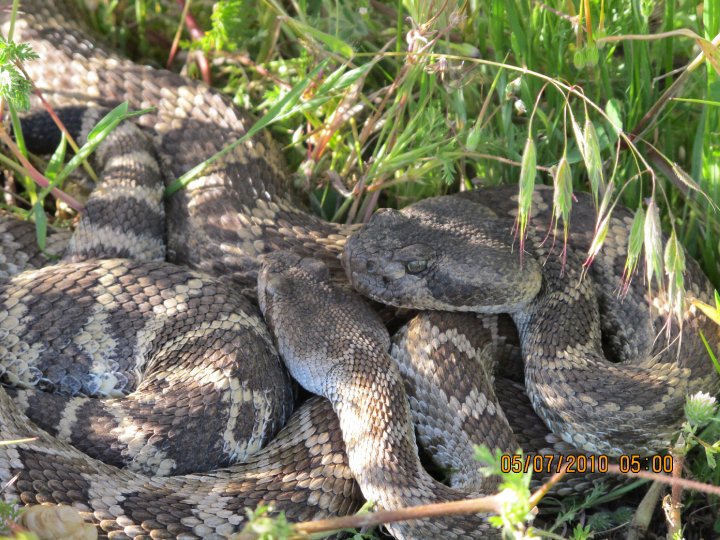
PERL has now begun conducting research on rattlesnakes at Vandenberg Air Force Base! This gorgeous area occupies a gigantic swath of land in northern Santa Barbara County. Most of it is pristine, inhabited not by humans but by a motley crew of flora and fauna, including lots of threatened and endangered species. And it is FULL of rattlesnakes-- most definitely neither threatened nor endangered.

Near the beach there are beautiful dunes:


And inland there are rocky hillsides (that's the city of Santa Maria in the background):

We saw about 15 rattlesnakes just in the rocks visible in this photo:

These are Southern Pacific rattlesnakes (Crotalus oreganus helleri), whereas for the past six years we have been studying Northern Pacifics (C. o. oreganus) about 50 miles to the northeast. It's probably a big intergrade zone, really.

Since it's fall, and the air is cool but the sun is warm, most of the snakes are hiding under the rocks, sticking body parts out into the sun:

In the words of Roger Repp, "Where's Waldo?" (Hint: There are two rattlesnakes in this photo.)

Rodent burrows are also favorite spots for snakes to hang out:

In two days out hunting, we saw about 10 male-female pairs! The Northern Pacifics would have been done with mating season by now (because inland it's cold at night?), but the coastal snakes are apparently going strong. If you look closely you'll see a little girl under this boy:

The big question is: Why are there so many snakes here? Could be the weather, could be the isolation from humans, definitely is the massive number and variety of rodents. Everywhere you look you see mouse burrows:

Ground squirrel burrows:

And gopher mounds:

The result is heaps of rattlesnakes that grow FAST. See this medium-sized male that Scott is holding?

Look at his rattle! This snake is no older than three years. He's huge for that age! Nothing like a steady supply of tasty voles to fuel rattlesnake biomass.

And one more cool thing: BABIES! (These are Northern Pacifics from inland though)

Stay tuned for a lot more snakey updates from VAFB!

Saturday, August 13, 2011

Rattlesnake Research at Cal Poly

Celebrating 5 fun-filled years of rattlesnake research in the Physiological Ecology of Reptiles Laboratory at Cal Poly! In this post, I want to introduce you to some of the cool things we have seen rattlesnakes doing, and to the students who have made it all happen.
We do not keep a colony of rattlesnakes at Cal Poly. We only keep rattlesnakes in captivity for short periods of time while they are outfitted with radiotransmitters for our research on their physiology and behavior. The students spend most of their quality time with the snakes not in the lab, but in the field.


One of the great things about studying rattlesnakes is that they are large enough that we can insert a Holohil Systems 13-gram radiotransmitter (about half the width and length of a tube of lipstick) into the snake's body cavity. The battery last for two years, allowing us to track the same snake for extended periods without multiple surgeries.

To anesthetize the snake, it is gassed with isoflurane in a plastic tube (all surgery photos by M. Feldner):
Then a small incision into the body cavity is made, and the sterilized radiotransmitter is inserted:
We also insert a Thermochron iButton datalogger, which collects data on the snake's internal body temperature at whatever intervals you like (usually every 1-2 hours in our studies):
All sutured up:
To wake the snake up, a tracheal tube is inserted into its glottis:
Then I blow into the tube to inflate the snake's lung with air, so when the air comes out, so does the isoflurane, and snake wakes up.
Then the snakes are returned to the field site and can be radiotracked to locate them as often as you want, to get data on behaviors, movement, etc., or to collect the snakes for blood sampling. Here is Kyle, one of the first students to work on snakes with me at Cal poly (2007). (Incidentally, Kyle couldn't stay away and is beginning his graduate work with me next month... on lizards!)
Snakes are recognizable in the field not just by radiotracking, but by their unique, colored rattle paint code:
Our field site is the Chimineas Ranch unit of the Carrizo Plain Ecological Reserve. This is a ~30,000 acre ranch that is managed for cattle, game, and wildlife. Its northern edge is studded with water impoundments and rocky outcrops that comprise perfect rattlesnake habitat:
The ranch also has a beautiful house with pool and hot tub that you can rent while you do research.
Current graduate student Tony in the poolside cookhouse:
The past five years of research on this species, the northern Pacific rattlesnake, have yielded all sorts of interesting natural history data. A very common sight in the spring (also in the fall, but less so) is courting rattlesnakes. Males coil next to or on top of a female, and run their chins all over the female's back in the hopes that she will become receptive to his advances. Males often stay with females for prolonged periods of time.

In the late spring the rattlesnakes are commonly found with food bulges that are suspiciously similar in size to a juvenile ground squirrel:
Sometimes we are lucky enough to witness the feeding events itself. Recently graduated grad student Matt (now off to start his PhD studying venom ecology at Ohio State) took this photo of a snake mowing a kangaroo rat.
Another snake eating a kangaroo rat, this time on the ranch house grounds (photo by J. Ahle):
Here is one of our radiotagged snakes eating a bird. We didn't get close enough for a positive ID on the bird for fear of disturbing the snake, but it might be a cowbird or blackbird:
Rarely, we found the predator becoming prey. Here, an adult California kingsnake is constricting an adult female rattlesnake (photo by M. Feldner):
We strive to make our activities accessible to as many people as possible, to demystify rattlesnakes and show the public how docile and beautiful rattlesnakes are in their natural habitats. We bring groups of students from Cal Poly's Wildlife Club, Herpetology class, etc. to the ranch to see the herps. Here Tony is allowing students to touch a safely restrained rattlesnake.
Jordan was an undergraduate studying thermal biology of the rattlesnakes (2009):

Bree did her undergraduate research project with me in 2009 on rattlesnake spatial ecology, and is now getting her PhD studying rattlesnake-rodent behavioral interactions (You can read her blog here).


Peter (left) and Craig were respectively undergraduate and graduate students doing some of the earliest work on rattlesnakes in my lab (2007-2008). Craig is now pursuing his PhD studying physiology of timber rattlesnakes at the University of Arkansas.


Vince, a community college student doing research on snake brains in my colleague Christy Strand's lab, came out for a chance to hold one of his study animals (2010):


Those pair-bonded to the PI also get a chance, especially when he finds 75% of the snakes in a given day. Here's Steve holding his first rattlesnake (2010):
Other than outreach, why are we actually holding rattlesnakes? Because our research questions often require us to collect blood samples to measure hormone concentrations, lending us the dubious titles of Snake Vampires. Here, current undergraduate Scott (left) and Tony take a blood sample from the caudal vein of a snake:
On another day, Tony and Matt take a sample:
You can read more about PERL's rattlesnake research at our website and publication site. Look for more coming soon as all the boys (and Bree gal) publish their stuff!


Thursday, August 4, 2011

Horseshoe 2 Fire

(photo by Sheri Ashley)

On Mother’s Day, 2011, the Horseshoe 2 fire broke out in the Chiricahua Mountains in SE Arizona. The exact cause has yet to be identified, but it is said to be human-set, perhaps from an untended campfire. The result was devastating: almost the entire mountain range, a full 230,000+ acres, was burned. Parts are okay, other parts are bad, many are worse.

Here is a NASA map showing the area burned by the fire (basically the whole mountain range):
I was very unnerved when I heard about this fire back in May. The Chiricahuas are one of my favorite places on the planet. I have been herping here for 13 years. Its biodiversity rivals any other place in the US. I was all set to teach the first herpetology course offered by the Southwestern Research Station, a chance to spend 10 days in the mountains and surrounding desert. All this and more was at risk with this massive fire.

Luckily, the firefighters were able to set backburns around the research station to save it, and lower Cave Creek Canyon is reasonably untouched by the fire. Here is a backburned area near the Herb Martyr campground. The brush burned, but the trees should live:

But just up the hill from Herb Martyr, this is what you see. It's just awful.
The conditions that led to the extreme magnitude of this fire have been described as a “perfect storm.” First the area was in a major drought this spring, having had virtually no winter rains. Second, in February there was a major freeze that caused many oak tree limbs to fall to the ground, providing tinder. Third, the fire started in May, over a month before the onset of the summer monsoon rains- normally, fires here are caused by lightning during the monsoons and are quickly put out. Finally, and devastating and inexplicable, unusually high winds rose up right when the fire started, throwing embers across the range and causing a virtual explosion.

But the course went on, and we had an amazingly successful herping session, as described here, here, and here. But everywhere we went in the mountains, we were reminded of the devastation wrought by this fire. All the campgrounds were closed for fear of floods and landslides. Even access to hiking and driving through most of the mountain range was closed. From Portal, the highest up you can get is Turkey Creek, then you hit this:
Above Turkey Creek, sights like this are common:
Word has it that areas higher up the mountains, including Onion Saddle and Rustler Park, are burned to a crisp. This is so hard for me to imagine. I was terribly disappointed that we didn’t get a chance to view this in person. By staying down at the research station, where the habitat is relatively untouched, I felt like I was being kept from seeing the reality of the situation. As we did our class, I felt guilty, guilty that I went about my herping business as though everything was fine, when my mecca was horrifically wounded. It was a terrible, powerless feeling.

I found myself taking a much deeper look at the non-herp things around me than I normally would. I looked at plants! And they were amazing! All around me, sprouts were bursting forth from the charred bodies of their parents.
I am not a plant biologist. I am not a fire ecologist. But I am an optimist. Maybe it’s because I cannot bear the idea of my beautiful mountains dying. That’s right, fire! Those are MY mountains! And you cannot take them from me. They’ll be back. And so will I.